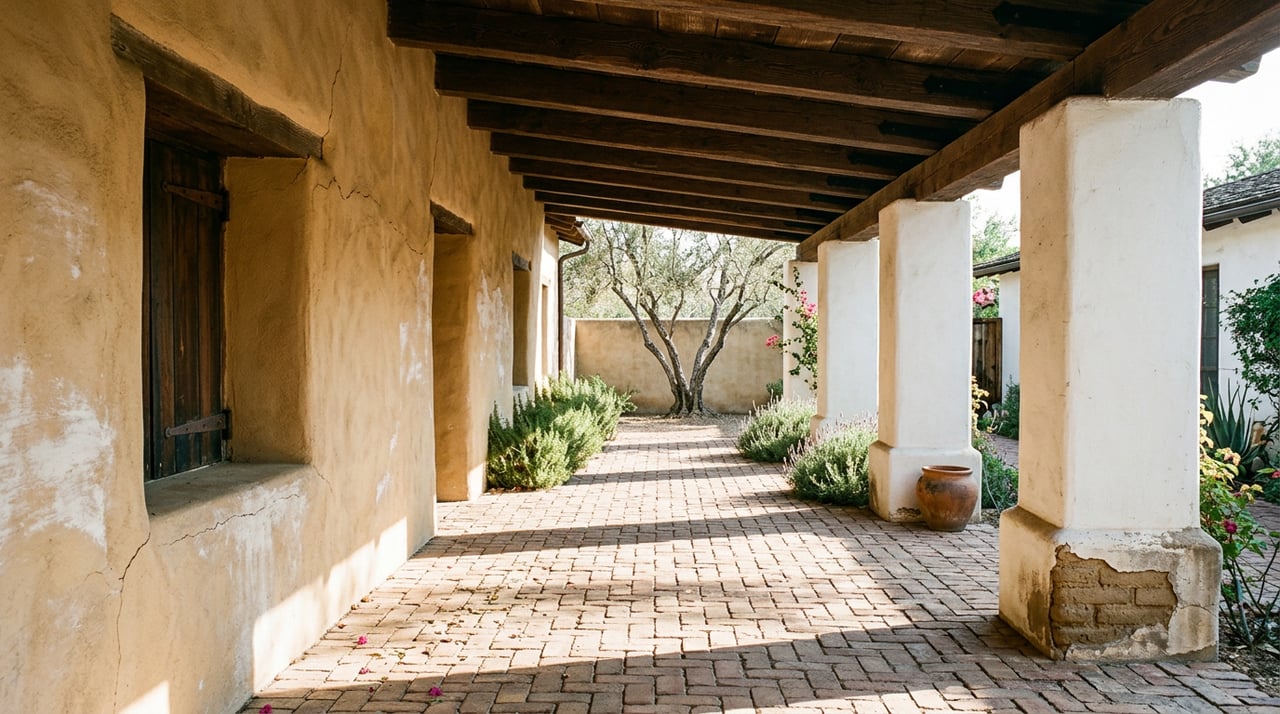
In December 2025, San Juan Capistrano's Cultural Heritage Commission approved a plan to restore two of the city's oldest structures, the Domingo Yorba Adobe and the Casa Manuel Garcia Adobe, and fold them into a 70-room boutique hotel downtown. Weeks later, in January 2026, the same developer asked the commission to rescind the approval it had just won. By March, the city had opened a fresh environmental review on the project, effectively restarting the process from the beginning.
That reversal is not a story about hotels. It is a story about what it actually means to hold a landmark designation in this city, and it matters just as much for a three-bedroom cottage in Los Rios as it does for a commercial project on Camino Capistrano. If a professional development team with counsel and consultants can win an approval and then need to unwind it, a homeowner planning a kitchen addition on a designated 1920s bungalow should not assume the same process will be quick, predictable, or final on the first try.
Most of what gets written about historic homes in San Juan Capistrano focuses on the Mills Act, the property tax reduction available to owners of buildings on the city's Inventory of Historic and Cultural Landmarks. The tax math is real and worth understanding. But it is the smaller half of the story. The larger half is what happens after closing, when you want to change something about the house, and the answer runs through a five-member commission whose decisions are not guaranteed and, as the French Hotel showed, are not always permanent even once granted.
What Actually Transfers When You Buy the House
A Mills Act contract is recorded against the property, not the person who signed it. That means it runs with the land: when the house sells, the contract transfers automatically to the new owner along with whatever restoration and maintenance commitments the seller made to the city. If the seller fell behind on a repair the contract called for, that obligation does not stay with the seller. It becomes yours.
This matters because the penalty for a contract found in breach is steep. Under California Government Code, if a city cancels a Mills Act contract for noncompliance, the owner at the time of cancellation owes a fee equal to 12.5 percent of the property's current fair market value. On a home valued in the mid seven figures, which describes a fair number of the historic properties in this city, that is not a rounding error. It is a number that belongs in your due diligence math, not just your escrow paperwork.
The city's own guidance on the program confirms the contract is only available to properties already on the Inventory of Historic and Cultural Landmarks, and that the tax formula the county assessor applies can produce reductions ranging roughly from 15 to 60 percent depending on the property. That range is wide enough that the number quoted to you by a seller means very little until the assessor runs the actual formula for your specific home.
| Mills Act contract | Landmark (IHCL) designation | |
|---|---|---|
| What it controls | Property tax assessment method | Whether future work needs city review |
| Transfers on sale | Yes, automatically, contract runs with land | Yes, designation stays with the property |
| City approval to sell | Not required | Not required |
| Risk if ignored | 12.5% cancellation fee on breach | Denied or delayed Site Plan Review |
| Who enforces it | County assessor and city, periodic inspection | Cultural Heritage Commission |
The Approval Process Isn't Automatic Either
Being on the Inventory of Historic and Cultural Landmarks triggers something separate from the tax contract: any alteration, addition, relocation, or demolition involving the property requires a Site Plan Review by the Cultural Heritage Commission. This is true whether or not the owner ever applied for Mills Act tax relief. Landmark status alone puts every future renovation through this filter.
The commission's reach extends beyond the landmark itself. In the fall of 2025, a proposed Chipotle Mexican Grill on Del Obispo Street needed the commission to determine whether the new building would be physically and aesthetically compatible with the adjacent Blas Aguilar Adobe, a structure on both the city's local register and the National Register of Historic Places. The restaurant was not the historic property. It simply sat next to one, and that was enough to require a compatibility finding.
If a fast food build-out next door to a landmark needs a commission finding, a homeowner's addition to the landmark itself should expect at least that level of scrutiny, and probably more. The French Hotel sequence is the clearest evidence available that even a fully vetted, professionally represented Site Plan Review can be approved and then walked back. That is the risk a buyer of a designated property is taking on, whether or not anyone points it out before closing.
Before You Write an Offer
If you are considering a home on the Inventory of Historic and Cultural Landmarks, whether it is in the Los Rios Street Historic District or one of the early twentieth century cottages in the Mission Hill-Mission Flats area, a few questions belong in your offer strategy before they belong in your inspection contingency.
- Ask for the recorded Mills Act contract itself, not a summary of it. The contract includes the specific work plan the current owner agreed to, with cost estimates and a timeline. Read what is left undone.
- Ask when the property was last inspected by the city or the assessor's office for compliance. A gap of several years without inspection is not disqualifying, but it is information you want before you own the liability.
- Confirm the property's exact designation category. A single landmark building, a contributing property within a historic district, and a property merely adjacent to a landmark all face different levels of review, as the Chipotle case demonstrated.
- If you have renovation plans, price in the Site Plan Review timeline as a real cost, not a formality. Ask what has gone through the commission recently and how long it took, including anything that had to be resubmitted.
- San Juan Capistrano does not require Cultural Heritage Commission approval to sell or lease a designated landmark. The city does ask that the commission's secretary be notified of the ownership change so its records stay current. It is a small step, optional in the strictest sense, but it is the kind of detail that keeps a landmark's paper trail clean for whoever owns it next.
One property that illustrates the upside of doing this well is a 1929 cottage in the Historic District known locally as the Father O'Sullivan House, designed by Clarence Lobo, an Acjachemen tribal leader, and carrying a recorded Mills Act contract. Its connection to Father St. John O'Sullivan, who led the Mission's restoration beginning in 1910, is part of what made it worth designating in the first place. A home like that carries real value precisely because its story and its paperwork have stayed aligned. That alignment is the work, not an afterthought to it.
FAQ
Does the Mills Act tax benefit disappear when a historic home sells? No. The contract runs with the land and transfers to the new owner automatically. The county continues to apply the same Mills Act formula each year on the January 1 lien date, so the benefit continues rather than resetting to a market-rate assessment the moment the deed changes hands.
Do I need the city's approval to sell a landmark home in San Juan Capistrano? No. The Cultural Heritage Commission does not need to approve or even be notified of a sale, though the city recommends notifying the commission's secretary so ownership records stay accurate.
What actually requires a Site Plan Review? Any alteration, addition, relocation, or demolition involving a property on the Inventory of Historic and Cultural Landmarks, and in some cases work on a neighboring property when it could affect a landmark's setting, as the recent Chipotle review near the Blas Aguilar Adobe showed.
A landmark home in San Juan Capistrano rewards the buyer who reads the fine print before the offer, not after the inspection contingency expires. If you are weighing a Mills Act property in the Los Rios District, Mission Hill-Mission Flats, or elsewhere on the city's inventory, Mark Kojac can walk through the recorded contract, the designation history, and what a realistic renovation timeline looks like before you commit. Reach out for a free home valuation and a straight answer on what you would actually be taking on.