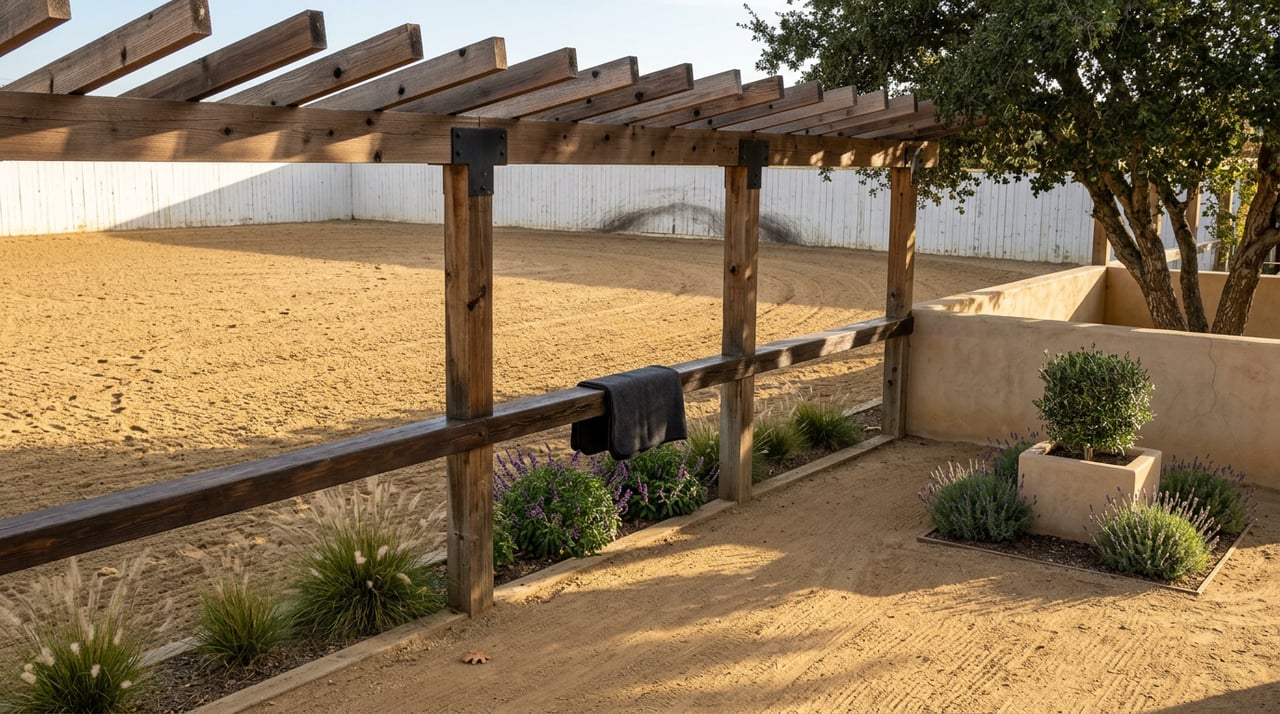
Beginning in 2025, the City of San Juan Capistrano moved to vacate a public equestrian easement that had sat on nine parcels off Aguacate Road and Calle Roberto since 1977. The city had formally accepted it in 1983. For more than four decades, it existed on title reports and plat maps as an equestrian right of way, the kind of language that shows up in a listing description as a selling point. The planning commission's own filing tells you why it finally got removed: the easement was never improved as a public equestrian trail, never connected to a public trail or facility, and never maintained by the city. It was a line on a map that did nothing for anyone who owned a horse.
That is the story worth knowing before you fall in love with the word "equestrian" on a San Juan Capistrano listing. The word does two different jobs at once. One is descriptive, the lifestyle promise of trails and barns and a certain kind of privacy. The other is regulatory, a specific answer to whether the city will let you keep an animal on that parcel at all. Only one of those two jobs is enforceable, and it is not the one that shows up in the marketing copy.
The math your acreage has to survive
San Juan Capistrano's municipal code does not treat "equestrian" as a lifestyle category. It treats it as arithmetic. Under Section 9-3.515 of the city's equestrian standards, horses are permitted only in five base zoning districts: Agri-Business, Residential/Agriculture, Hillside Residential, and the two large-lot single-family districts known as RSE-40,000 and RSE-20,000. Land outside those five districts does not get to keep a horse regardless of how large the lot is or how the listing reads.
Inside those districts, the ratio is fixed: one equine per 10,000 square feet of overall lot size, with a minimum of 2,500 square feet for the first horse, of which at least 500 square feet has to be flat ground with a slope no steeper than 10 percent. Each additional horse needs another 500 square feet of that same flat ground. Paddocks and stalls have to sit at least 100 feet from any school or hospital and inside a fence at least five feet tall, and any structure needs a 20-foot front-yard setback.
None of that is where most buyers get surprised. The surprise is what happens once the lot crosses two acres.
The step nobody mentions at the open house
Run the ratio out on paper and it looks like a smooth line: bigger lot, proportionally more horses. That is not how the city's permit threshold actually works.
| Lot size | What the 1-per-10,000-sq-ft ratio implies | What's allowed without a Conditional Use Permit |
|---|---|---|
| 1 acre (43,560 sq ft) | About 4 horses | 4 horses |
| 2 acres (87,120 sq ft) | About 8 horses | 4 horses |
| 5 acres (217,800 sq ft) | About 21 horses | 6 horses |
Below two acres, the permit-free cap and the ratio math roughly agree. Cross two acres, and the ratio keeps climbing while the permit-free cap barely moves, from four horses up to six, no matter how much additional acreage sits behind that threshold. A five-acre parcel that looks, on paper, like it could comfortably support twenty animals is legally capped at six unless the owner goes through a Conditional Use Permit process with the city, which weighs site suitability, compatibility with neighboring properties, and the specific number the location can support.
For a buyer moving from a suburban lot to acreage specifically to expand a horse operation, that gap between what the land could theoretically hold and what the city will let you keep without additional approval is the number that actually matters, not the acreage on the listing sheet.
A rising median doesn't answer the zoning question
San Juan Capistrano's home values have been climbing. Homes that closed in June 2026 sold at a median price up 14.5 percent year over year, with a median of 34 days on the market, a pace that reflects real demand for what the city offers. But that citywide median is an average across a market that does not behave like one market. Zillow's neighborhood-level figures put typical values as low as the high $800,000s in the Bridgepark District and above $3 million in Covenant Hills Village, and Realtor.com has listed homes in Marbella at over $3 million as well. A single median tells you the city is appreciating. It tells you nothing about whether the specific parcel you're touring sits in one of the five zoning districts where a horse is even legal.
This is the part that trips up buyers who are shopping by price point and lifestyle description rather than by parcel. A $2 million equestrian-style estate and a $900,000 single-family home in a different district can both use the same real estate marketing language, and only one of them may actually be zoned to support the use.
An easement is not a trail
The Aguacate Road case is not an isolated clerical cleanup. It is a reminder that a right recorded on paper only means something if it was actually built, connected, and kept up. San Juan Capistrano has real infrastructure that does that work, which is exactly what makes the gap visible when a piece of paper fails to.
The San Juan Capistrano Equestrian Coalition, a volunteer group that started in 2003, has spent two decades on the unglamorous parts of trail access: printed trail maps, a GPS interactive trail map for the city's own website, and two commissioned economic impact reports that put a number on what the equestrian community contributes locally. The coalition also partners with the city on the Capistrano Greenery, a composting program that turns manure and shavings from local stables into usable compost for city, county, and private landscaping. You can read more about that work directly from the coalition itself.
The 40-acre Rancho Mission Viejo Riding Park is a public facility that hosts everything from Olympic-caliber show jumping to rodeos and includes its own walking and riding trail, open to visitors rather than gated off as a private amenity. Long-running local operations, including Ortega Equestrian Center, family run since the early 1980s, and the San Juan Capistrano Equestrian Center, which traces its roots back roughly 60 years under its earlier name Sycamore Trails, are part of the same network of boarding, training, and trail access that makes the word "equestrian" mean something specific in this city rather than functioning as a generic real estate adjective.
That infrastructure is what the Aguacate Road easement never had. It sat on a title report for over 40 years without ever plugging into any of it.
Where the paperwork and the pasture agree
The Hunt Club is the clearest example of zoning and functioning infrastructure lining up. Most of its homes were built in 1989, guard-gated, ranging from roughly 3,443 to 11,500 square feet, with direct access to equestrian trails and proximity to Marbella Country Club. Buyers there are not relying on a dormant easement. The trail access is active, connected, and used, which is a large part of why the neighborhood has held its premium pricing over decades rather than trading on a designation that turned out to be paper only.
That contrast is the whole point. Two properties can carry the same word in their listing description. Only a look at the actual zoning district, the acreage math against the CUP thresholds, and whether any referenced easement or trail is functionally connected will tell you which one is real.
If you're comparing equestrian properties in San Juan Capistrano and want someone who reads the zoning map before the listing photos, that's the work I do. Reach out to Mark Kojac for a free home valuation and a straight answer on what a specific parcel will actually let you do with it.