This October, a cyclist wrote to the Orange County Register's Honk column about the striped crossing on La Novia Avenue at the San Juan Creek bridge. When he tried to cross there on his mountain bike, he said, drivers rarely stopped, and that included California Highway Patrol cars. He asked whether the crossing was "just something for looks."
The city's answer was that it isn't decoration and it isn't a crosswalk either. It's an equestrian crossing on the San Juan Creek Trail. It has been there for about ten years, and the two thick white lines are new paint on an old crossing. That paint is also the only new safety feature the crossing will get for years. The beacon, the separate equestrian path and the protected bike lane are all part of a bridge replacement, and the city now expects construction on that bridge to begin in 2030.
Ten Years Old, Painted Last Year
The Register quoted Sean Sabo, a principal analyst for the City of San Juan Capistrano. He said the crossing "has been in place for at least the past decade and provides a connection between portions of the city's trail network." Until recently it had no pavement markings. The thermoplastic stripes went down during a pavement rehabilitation project.
The June 2025 pavement plan put La Novia Avenue from San Juan Creek Road to Via Capri in Phase 1A. A city update in September 2025 said La Novia was next after Rancho Viejo Road and was expected to wrap up by the end of October 2025. So the crossing looks new because the paint is new, even though trail users have been crossing there for a decade.
The trail crossing it is long. The city's 2024 bridge study describes the San Juan Creek Trail as an OC Parks hiking and riding trail on the north side of the creek. It runs about three miles from near I-5 to Reata Park and Event Center and the Ortega Highway. It crosses La Novia at grade about 300 feet south of the Calle Arroyo intersection. The study calls this crossing "unprotected." It also notes that the existing bridge is too narrow to carry the trail over the creek.
The Route the Signs Point Walkers To
Signs at the crossing say it's for equestrians and that pedestrians shouldn't use it. Sabo told the Register that "pedestrians traveling through the area should use the nearby signalized crossing at La Novia Avenue and Calle Arroyo."
Honk described the route for walkers and mountain bikers coming along the creek like this:
- Leave the trail at La Novia and turn toward Calle Arroyo, about 300 feet north.
- Cross La Novia at the signal.
- Walk back down the other side to rejoin the San Juan Creek Trail.
That's roughly a 600-foot round trip to avoid a crossing that's right in front of you. Honk admitted he'd bet most walkers and bikers cross at the stripes anyway. For riders on horseback, the stripes are where the trail is supposed to cross. The paint makes that easier to see, but cars still have no signal telling them to stop.
Why Stopping Is Hard to Ask of This Road
The traffic count explains why drivers rarely stop. In its October 2025 funding application, the city reported that counts taken in September 2025 on La Novia between Calle Arroyo and San Juan Creek Road averaged 11,806 vehicles a day. The two-lane road is rated for about 12,500. That's a volume-to-capacity ratio of 0.94, which the city rates as level of service E.
The same document explains why traffic piles up there. La Novia is the only crossing of San Juan Creek east of I-5. The city and OCTA's master plan both designate it a Primary Arterial, meaning a four-lane divided road, but at the bridge it's still two lanes with no median. The city calls the existing bridge structurally and hydraulically deficient. It says the bridge's narrow width "restricts mobility for pedestrians, bicyclists, and equestrians."
So a horse, a hiker or a cyclist waiting at the stripes faces nearly a full road's worth of commuters on one of the city's busiest north-south routes. The posted speed on the bridge is 35 mph.
What the Replacement Bridge Adds for Trail Users
The La Novia Avenue Bridge Replacement Project, city project CIP 24106, covers La Novia from Calle Arroyo to San Juan Creek Road. The October 2025 application describes a bridge about 280 feet long and 92 feet wide. It would be built on deep foundations above a widened creek channel, and the old bridge would be demolished in phases. These are the parts that matter for anyone using the trail:
- A pedestrian hybrid beacon at the trail crossing. This is the traffic control the crossing lacks now.
- An equestrian trail connecting the San Juan Creek Trail to the Barking Dog Trail. The Barking Dog Trail is a city-owned path that starts at the southeast corner of La Novia and San Juan Creek Road and runs a little over half a mile into the surrounding neighborhood.
- A protected Class IV bikeway that ties into the existing Class I and Class II bike routes.
- An ADA-compliant sidewalk along the west side.
- Continued access to C. Russell Cook Park and the new Windmill Park.
The city says pedestrians, bicyclists and riders would be "physically separated from the travel lanes." With four lanes, the city projects the volume-to-capacity ratio would fall to 0.63, which it rates as level of service B. In 2025 dollars, the application put the total cost at $25.35 million. Construction makes up $22.725 million of that, with $14.38 million for the bridge structure. The city's preliminary engineering and environmental review is paid for with an $850,000 federal earmark and a $250,000 city contribution.
The Start Date Has Already Moved
At the September 17, 2026 State of the City, the replacement was described as advancing. The plan still calls for four lanes, a protected bikeway and a separate equestrian path. The schedule has moved since the October 2025 application, though:
| Phase | City's October 2025 application | City's statement, October 2026 |
|---|---|---|
| Preliminary engineering and environmental review | June 2025 to June 2026 | Still underway |
| Final design | August 2026 to July 2028 | Expected to begin in 2027 |
| Construction | April 2029 to January 2032 | Expected to begin in 2030 |
The October 2025 application also said that schedule was "contingent upon funding." In the newer dates, the start of construction moved back about a year, from April 2029 to 2030. If it starts in 2030, that's more than three years after this week. Even then, the beacon and separate trail facilities come with the new bridge, which will be demolished and rebuilt in phases. Until that work is done, the crossing has signs, the stripes from last year's repaving and the signal at Calle Arroyo.
On the San Juan Creek Road Side
The trail network south of the creek is filling in before the bridge does. Windmill Park opened in November 2024 at the northwest corner of La Novia and San Juan Creek Road, next to San Juan Hills Golf Club, according to the Orange County Register. San Juan Hills Golf Club built it under a long-term lease the City Council approved in June 2023.
On September 24, 2026, the city posted a CEQA notice of exemption for a landscape maintenance agreement with San Juan Hills Golf Club. It covers a multi-use trail on the north side of San Juan Creek Road, starting at Windmill Park and running to the golf club's westerly property line. The listed features are decomposed granite surfacing, split-rail wood fencing, landscaping and irrigation.
The city's 2024 bridge study also proposed connecting Cook La Novia Park and Windmill Park across the creek. Today, the place where those two sides meet the San Juan Creek Trail is the striped crossing on La Novia. As the trails on either end grow, more riders, walkers and cyclists are likely to end up at a crossing that still has no signal.
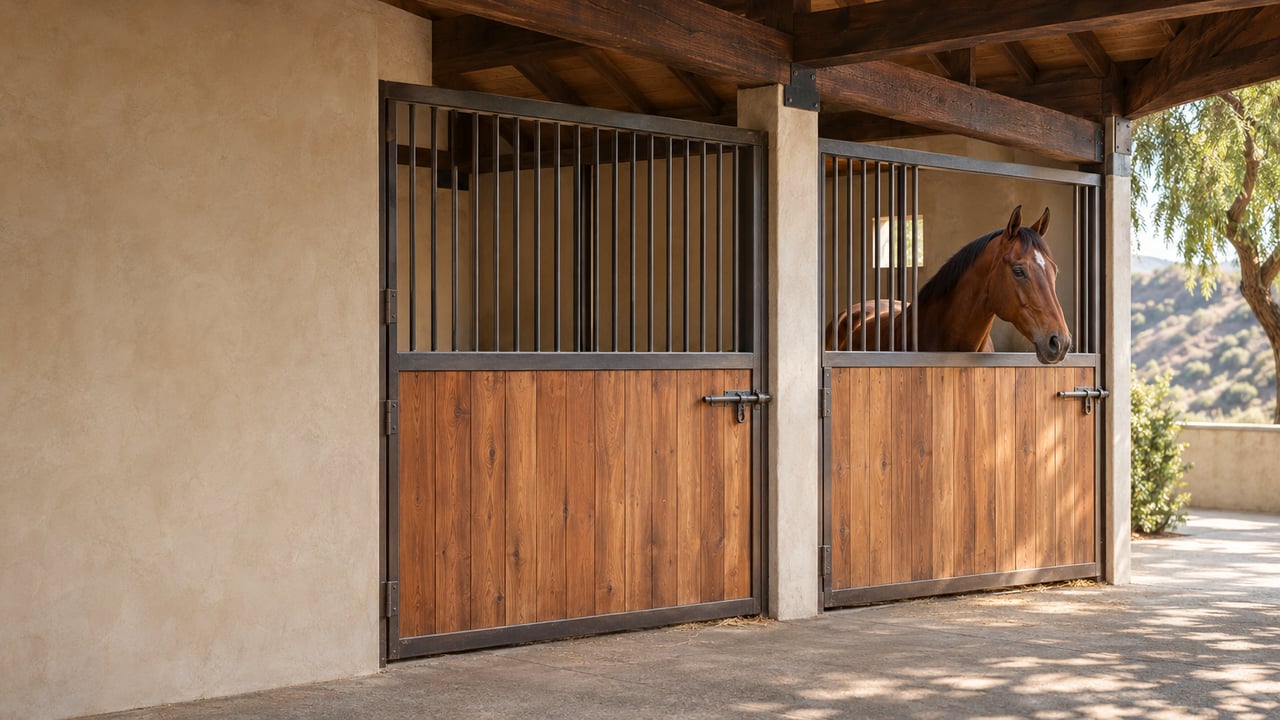
For an equestrian property owner, getting to a trail matters as much as the trail itself. A path that goes through a busy unsignaled crossing makes for a different morning ride than one that doesn't. If you own a horse property near the San Juan Creek Trail and want to understand how its trail connections and the timing of these projects may affect its value, Mark Kojac can walk the property with you and give you a free home valuation that accounts for both.