At San Juan Capistrano Equestrian Center, a Classic stall fed Timothy twice a day and alfalfa at noon comes to about $1,390 a month per horse. That uses the center's rate sheet effective September 1, 2025. For two horses the bill is about $2,780 a month. At Freddie Mac's 30-year fixed average of 7.11% for the week ending November 12, 2026, that is about the monthly principal-and-interest payment on $413,000 of mortgage.
That conversion is the useful number for a family moving here with horses. Portals will show you the price of a horse-zoned home. The board bill is the cost you live with every month if you buy a home without horse facilities. The two only compare once they're in the same unit. Converting the board bill also shows something the sticker prices hide. Most of a stall fee pays for daily labor and facilities, not feed. Hay is the one cost you pay either way, and California hay prices rose this fall.
The two posted rate sheets in town
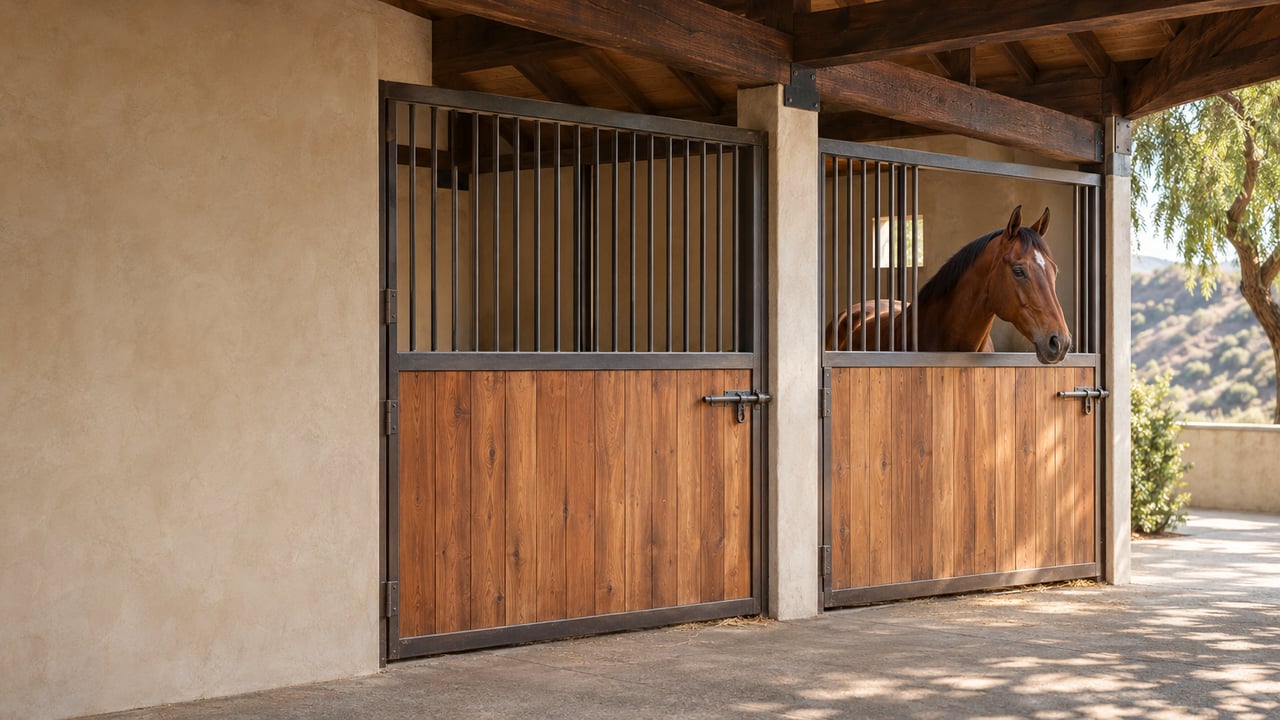
San Juan Capistrano Equestrian Center was formerly Sycamore Trails. It prices stalls by size. The Classic stall, about 12 by 12 feet, is $985 a month. The Signature, about 12 by 16 feet or larger, is $1,155. The Premium, about 12 by 24 feet, is $1,415. Those prices include water, bedding and daily stall cleaning, according to the center's rate page. Hay is billed separately by the portion, at $55 a month for cubes, $65 for alfalfa or Bermuda, and $85 for Timothy or orchard. The page notes that hay prices change with type and cost. The property has seven arenas, seven barns, round pens, a six-horse hot walker, wash racks and farrier stations.
Rancho Sierra Vista Equestrian Center, near Ortega Mountain Ranch, prices lower and splits its stalls by shade and shelter. Its pricing page lists Partial Shade at $340 a month, Breezeway $360, Box and Baja Box $550, Turn Out $700, Total Shade $845 and Double Box $990. Feed is priced by type and by the number of feedings a day. The page's own example is Timothy twice a day plus alfalfa once, at $255 a month on top of the stall. The page shows no effective date, so treat these figures as a starting point for a quote, not the quote itself.
There are other options in town. Ortega Equestrian Center offers boarding and training to South Orange County but posts no rates. Ortega Mountain Ranch describes itself as a private ranch for custom retirement and lay-up boarding. Mission Trails Equestrian Stables is at 28432 Calle Arroyo. The OC Register reported in March 2024 that it held 130 horses with three trainers on site. The city sold the 6.78-acre site on condition that it remain an equestrian stable. A June 2024 city Planning Commission report says the City Council approved the sale agreement on May 7, 2024, for continued stable operations.
Converting a board bill into mortgage dollars
Using the 7.11% rate, every $100,000 of 30-year mortgage costs about $673 a month in principal and interest. Dividing a monthly board bill by that figure gives the amount of mortgage the same money would carry. The table below uses the two rate sheets above with the same feed plan at each barn: Timothy, alfalfa, Timothy. These figures are my own arithmetic for illustration, not quotes.
| Scenario | Monthly board, all in | Annual | Mortgage the same payment carries at 7.11% |
|---|---|---|---|
| 1 horse, SJC Equestrian Center Classic stall | about $1,390 | about $16,700 | about $207,000 |
| 2 horses, SJC Equestrian Center Classic stall | about $2,780 | about $33,400 | about $413,000 |
| 3 horses, SJC Equestrian Center Classic stall | about $4,170 | about $50,000 | about $620,000 |
| 2 horses, Rancho Sierra Vista Box stall | about $1,610 | about $19,300 | about $239,000 |
The rate itself changes the answer. Freddie Mac reports the 30-year average a year earlier at 6.24%. At that rate the same $2,780 a month would have carried about $452,000 of mortgage instead of $413,000. Higher rates shrink how much house a board bill is worth. Rates have also fallen for four straight weeks, from 7.18% the week before. If that continues into spring, the break-even moves back toward the horse-property side.
The figure is general, and your own payment, taxes and insurance will differ. This is general information, not financial, tax or legal advice. Run your own numbers with your lender and the appropriate professionals before you act on them.
Most of the stall fee pays for daily care
Look at what the $985 covers. San Juan Capistrano Equestrian Center's rate page lists water, bedding and daily stall cleaning, and the property includes arenas and barns that a homeowner would otherwise build and maintain. Hay is extra. In the feeding example above, the stall is about 70% of the monthly bill and feed is about 30%.
Bringing horses home doesn't make that 70% disappear. You pay it in other ways. The shavings come from a feed store. The Canyon Feed and Foothill Feed online catalog lists Mallard Creek Mini Flake in 5-cubic-foot bags at $11.20, Mallard Creek Classic in 7.5-cubic-foot bags at $12.35, and JTS Fresh Pine at $15.20. American Horse Products in San Juan Capistrano stocks Premium Pine compressed bales, Fine Pine bales and 40-pound stall pellets, though its website lists no prices.
Manure becomes your job too. CR&R, the city's waste hauler, lists horse manure among green-cart materials on its San Juan Capistrano residential page. Collection is weekly, and carts come in 35-, 60- and 90-gallon sizes. For larger volumes, CR&R offers special collection containers from 3 to 40 cubic yards. Before you close on a barn property, ask CR&R directly what the service will handle for the number of horses you plan to keep.
The labor itself has no posted price anywhere, because at home someone in the household does it every day. In the table, that labor is most of the gap between a board bill and a hay bill. A household with a rider who wants to do barn chores comes out far ahead with a barn at home. A household that would hire the work out gives back much of the gain.
Hay costs you either way
Feed is the one cost that stays about the same wherever the horse lives. At a boarding barn it comes through as a portion charge that changes with the market. At home you buy it by the bale. Canyon Feed in Trabuco Canyon delivers to San Juan on Mondays and Thursdays, and its Saturday hay-sale discounts are for pickup only. Its online hay catalog lists #1 alfalfa at $26.70 a bale, premium alfalfa at $31.70, Bermuda at $26.70, orchard at $39.50, an orchard and alfalfa mix at $38.20, and Lifto Timothy at $42.50. The store notes that in-store prices may differ from online prices.
Those prices are moving. AgWest Farm Credit's November 12, 2026 market update says California hay production is down 14.5% from the prior year. It also says retail prices rose $25 a ton over the past month, and high freight costs are limiting how much hay comes into the state. The same update puts California diesel at a peak of $8.25 a gallon this fall. San Juan Capistrano Equestrian Center's own rate page warns that hay portion prices change with cost. So the rise reaches you whether the horse is boarded or at home.
Keep feed out of the break-even math. It doesn't decide between boarding and keeping horses at home, because you pay it either way. The decision comes down to the stall fee, set against the extra cost of the house plus your own time.
Running the test on a real property
The break-even gives you a number to bring to a showing. For a household with two horses at Classic-stall prices, the home that can keep them needs to cost less than about $413,000 more than the home that can't, at the November 12 rate. Shavings, manure service, upkeep on the barn and fencing, and the value of the daily chores also have to fit inside that gap. If you'd board at Rancho Sierra Vista prices, the margin shrinks to about $239,000.
The other house on that comparison has to really be a horse-keeping home and not just carry the label in its listing, a gap I wrote about in The Gap Between an Equestrian Listing and an Equestrian Lot in San Juan Capistrano. The appraisal raises a second issue. Private barns and arenas are where a lender's appraisal can come in below the sale price, as I described in the Mission Hills Ranch post, Why Mission Hills Ranch Skips the Acreage Cliff, But Not the Appraisal Gap. A horse-keeping premium you pay in cash, beyond the appraised value, changes the math above.
If you own a horse property in San Juan Capistrano, the same arithmetic works from the other side. Every buyer touring your barn is paying a board bill now or will be soon. A buyer who sees that their two stalls in town cost about $33,000 a year is looking at your barn, arena and manure setup as a cost they'd stop paying.
If you're deciding whether a horse property pays for itself against boarding, or pricing your own barn for buyers who are doing that math, Mark Kojac can run the comparison on the specific parcels you're considering. Start with a free home valuation and we'll go through what the land, the barn and the stalls are worth to a buyer who would otherwise be boarding.